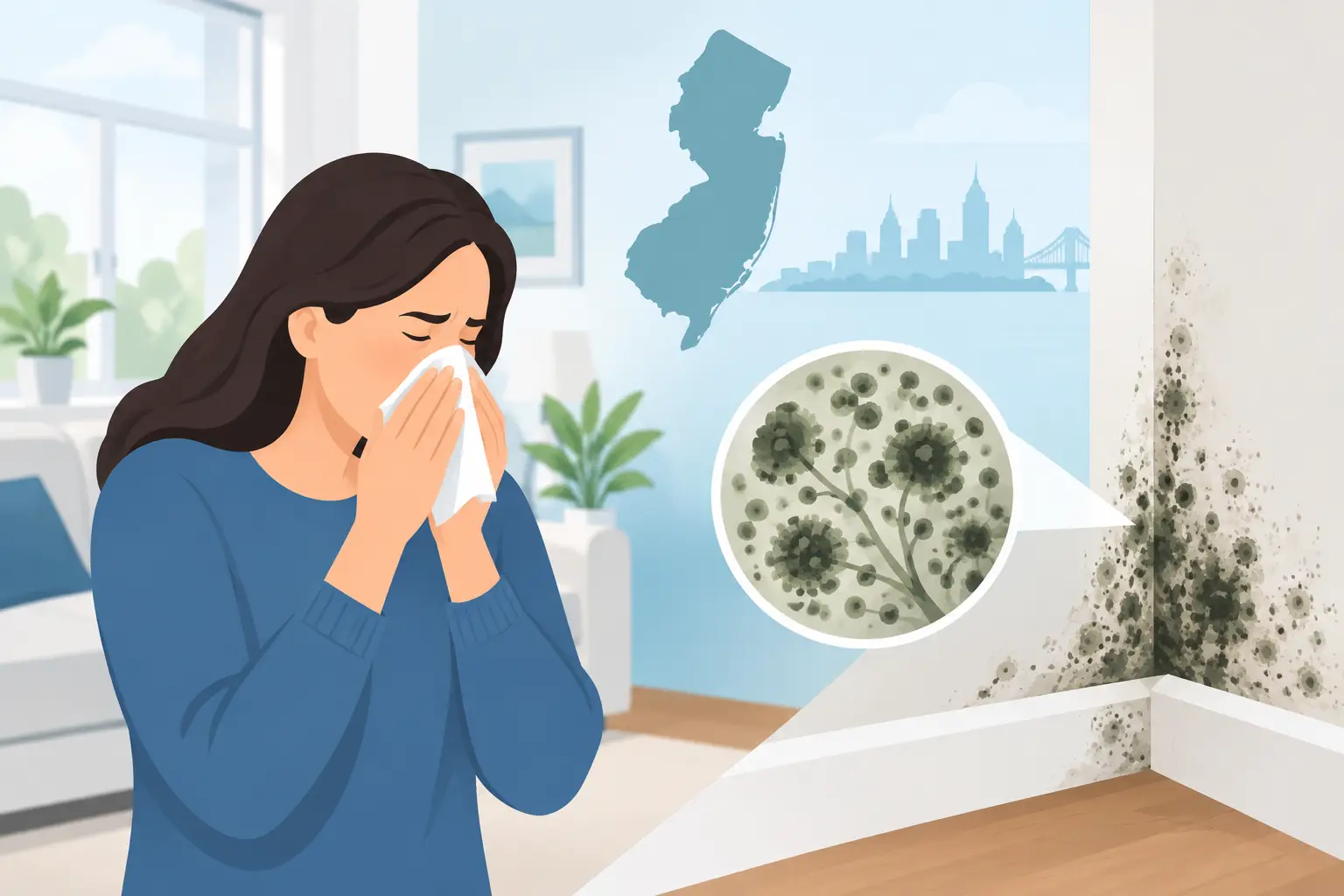
A musty smell after a basement leak is easy to dismiss as an inconvenience. But when a family member begins sneezing indoors, wakes with congestion, or notices itchy eyes that improve after leaving the house, the moisture problem may also be an indoor air quality concern. Homeowners often ask, “Can mold cause allergies?” For people who are sensitive to mold, the answer is yes.
Mold-related allergy symptoms can overlap with seasonal allergies, colds, dust exposure, and other respiratory irritants. That overlap is exactly why a professional inspection matters. In Northern and Central New Jersey, recurring basement dampness, roof leaks, plumbing failures, humid summers, and storm damage can create concealed mold conditions that are not always visible on a wall or ceiling.
Can Mold Cause Allergies and Respiratory Symptoms?
Mold reproduces by releasing tiny spores into the air. These spores are a normal part of the outdoor environment, but elevated indoor levels can become a concern when moisture allows mold to grow inside a home. A person with a mold allergy may have an immune-system response after exposure to airborne spores or mold fragments.
Common symptoms may include sneezing, a runny or stuffy nose, itchy or watery eyes, throat irritation, coughing, wheezing, or skin irritation. People with asthma may experience worsened symptoms when exposed to moldy environments. Infants, older adults, and people with existing allergies or respiratory conditions may be more vulnerable to irritation.
Symptoms alone cannot prove that mold is present or identify a particular mold type. They also should not be used to self-diagnose an illness. However, the timing of symptoms can be useful information. If discomfort becomes more noticeable in one room, after rainfall, near a damp basement, or while the heating and cooling system is running, the home should be evaluated for moisture and possible mold growth.
Why New Jersey Homes Are Especially Prone to Moisture Problems
New Jersey properties face a combination of conditions that can support indoor mold growth: humid summer weather, snowmelt, heavy rain, aging foundations, storm-related roof damage, and older plumbing components. A finished basement may look dry and well maintained while moisture is collecting behind wall panels, beneath carpet, or around a foundation crack.
Morris, Sussex, Warren, and Somerset County homeowners frequently encounter moisture issues in basements, crawl spaces, attics, and bathrooms. In some homes, the cause is straightforward, such as a visible pipe leak. In others, it is intermittent water intrusion that occurs only during heavy rain, ice dam formation, or periods of high humidity.
Mold needs moisture to grow. Removing visible growth without correcting the source of water is not a lasting solution. If a leak, drainage issue, or ventilation problem remains, new growth can develop in the same area or spread to adjacent materials.
Visible Mold Is Not the Whole Story
Not all mold is obvious. A dark spot on drywall may be mold, staining, or a past water mark, and a clean-looking surface can conceal growth behind it. Musty odors are often an early warning sign, particularly in enclosed spaces such as utility rooms, closets, basements, and attics.
Concealed growth is more likely when water has affected porous building materials. Drywall, insulation, carpeting, padding, ceiling tiles, and unfinished wood can retain moisture and support mold growth if they are not dried correctly after a leak or flood. A professional inspection helps determine whether the issue is surface-level or extends into building materials and indoor air.
When Allergy Symptoms Point to a Mold Investigation
A mold inspection is worth considering when health symptoms occur alongside a known moisture event or an unexplained indoor odor. The strongest reason to investigate is not a single sneeze or a small spot of discoloration. It is the pattern: moisture, odor, recurring symptoms, and conditions that do not improve with ordinary cleaning or ventilation.
Professional evaluation is particularly appropriate after a roof leak, appliance overflow, plumbing failure, basement seepage, storm damage, or a history of flooding. Landlords should also take occupant reports seriously. A prompt assessment can protect tenants, limit property damage, and document the condition of the affected area before it grows into a larger dispute or repair project.
Testing may include a detailed visual inspection, moisture measurements, thermal imaging where appropriate, and air or surface sampling when results will help answer a specific question. Sampling is not a substitute for a thorough inspection. Its value comes from proper collection, comparison, and professional interpretation in the context of the building and its moisture history.
Why DIY Mold Cleanup Can Miss the Real Problem
Homeowners may be tempted to spray a visible area with a household cleaner and move on. For a very small, isolated surface issue with no ongoing moisture source, cleaning may be appropriate. But that approach has clear limits.
Scrubbing can disturb mold spores and fragments. More importantly, it does not reveal whether mold is present behind drywall, under flooring, inside insulation, or within a damp HVAC area. Painting over staining or using fragrance products to cover a musty smell can delay the actual repair while moisture continues damaging the structure.
Professional remediation is designed to address both the contamination and the source. Depending on the extent of the issue, that can involve containment, controlled removal of affected materials, HEPA filtration, cleaning of remaining surfaces, and verification that the moisture condition has been corrected. The scope should fit the situation. A small bathroom issue is not handled the same way as widespread basement contamination after repeated water intrusion.
What to Do if You Suspect Mold Allergies at Home
Start by documenting what you notice. Record where odors are strongest, when symptoms occur, and whether there has been a recent leak, flood, or humidity problem. Avoid disturbing suspicious material unnecessarily, especially if the affected area is large or hidden behind finished surfaces.
Next, address active water immediately. Stop leaks, remove standing water, and use appropriate drying measures. Do not assume an area is dry simply because the surface feels dry to the touch. Moisture can remain inside wall cavities, beneath floors, and in insulation long after a visible spill disappears.
Then arrange for a qualified mold professional to assess the property. A proper inspection provides a clearer basis for decisions about testing, cleanup, repairs, and moisture control. For New Jersey homeowners, this is especially valuable after storm exposure or recurring basement water problems, where the source may be structural rather than a one-time event.
If anyone in the home has persistent respiratory symptoms, asthma flare-ups, or other health concerns, consult a licensed medical provider. Mold professionals can evaluate the building environment, but medical professionals are the right resource for diagnosing and treating health conditions.
Protecting Your Home Beyond the Cleanup
Long-term mold prevention is largely moisture prevention. Keep indoor humidity controlled, use exhaust fans in bathrooms and kitchens, repair plumbing leaks promptly, maintain gutters and grading, and inspect attics and basements after severe weather. These steps reduce risk, but they do not replace an assessment when there is a known water event or persistent musty odor.
The practical goal is not to create fear around every spot or smell. It is to respond early, identify the real source of moisture, and avoid guessing about what may be affecting your home’s air quality. When allergy-like symptoms and moisture problems appear together, a certified inspection can provide the clarity needed to protect both the property and the people living in it.
Leave a Reply